
Why Your Bedroom Doesn't Feel Restful (And How to Fix It)

The bedding matches, the art is hung, and it still doesn't feel restful. Here's what actually drives rest in a bedroom — and it's not styling.
The bedroom is styled. The bedding matches, the nightstands are symmetrical, there's a piece of art above the headboard. And it still doesn't feel like a place you actually want to wind down in — it feels more like a hotel room you're passing through than a room built around rest.
This gap between "well decorated" and "actually restful" is one of the most common disconnects in a home, and it happens because rest isn't primarily a visual experience. A bedroom can look finished in every photo-ready way and still fail at the one job a bedroom actually has.
Why a Well-Decorated Bedroom Can Still Feel Unrestful
Styling addresses how a room looks. Rest is driven by how a room functions at 10pm and 6am — how much light gets in when you don't want it to, how much visual "noise" is still sitting in your field of view when you're trying to fall asleep, and whether the room does one job clearly or several jobs at once. None of that shows up in a styled photo, which is exactly why a bedroom can look complete and still not deliver the thing it's actually for.
The Three Real Drivers of a Restful Bedroom
1. Real Light Control, Not Just Nice Lamps
A bedroom needs to go convincingly dark on command and convincingly warm in the evening — two different problems, not one. Blackout-capable curtains or a liner solve the first; swapping the main overhead light for lamps with warm bulbs in the hour before bed solves the second. A room with beautiful pendant lighting that's still cool-white and still lets in streetlight through thin curtains hasn't actually solved either problem, covered in more depth in the room-by-room guide to layering lighting.
2. Nothing Visible That Represents Unfinished Work
A laptop on the dresser, a hamper in the corner, mail on the nightstand — none of it is a styling problem, but all of it reads as "there's still something to deal with" right at the moment you're trying to stop dealing with things. The fix isn't more storage furniture, it's a strict rule about what's allowed to be visible in this one room: sleep-related objects only, everything else given a home elsewhere in the house.
3. The Bed as the Room's Only Real Job
A bedroom that's also a home office corner, a treadmill room, and a place laundry gets folded is being asked to do several jobs that actively work against rest — a desk with a glowing monitor is a genuinely different signal to your brain than a room with nothing in it but sleep-related furniture. Where a second function can't be avoided, physically separating it (a folding screen, placing the desk out of the bed's sightline) matters more than how nicely that second zone is decorated.
The Overlooked Factor: Temperature
A bedroom that's slightly too warm undercuts every other fix on this list, and it's rarely diagnosed because it doesn't show up in how the room looks at all. Most sleep guidance points to somewhere around 65 to 68°F (18 to 20°C) as the range that supports the deepest, most restorative sleep, which is noticeably cooler than most people keep the rest of their home. Breathable natural-fiber bedding (cotton or linen over synthetic blends) and a ceiling or box fan for airflow solve this more reliably than adjusting the thermostat alone, especially in a room that runs warm relative to the rest of the house.
A Quick Way to Diagnose Your Own Bedroom
Lie down in the bed at the time you'd actually go to sleep and look around without getting up to fix anything yet. Is the room actually dark, or is light still getting in from somewhere? Is there anything in view that represents a task rather than rest — a screen, a pile, an unfinished project? Is there a second "zone" in the room competing with the bed for attention? Whatever you notice in that two-minute test is almost always the real issue, more reliably than staring at the room in daylight ever tells you.
Real Examples
The Beautifully Styled Room With Sheer Curtains
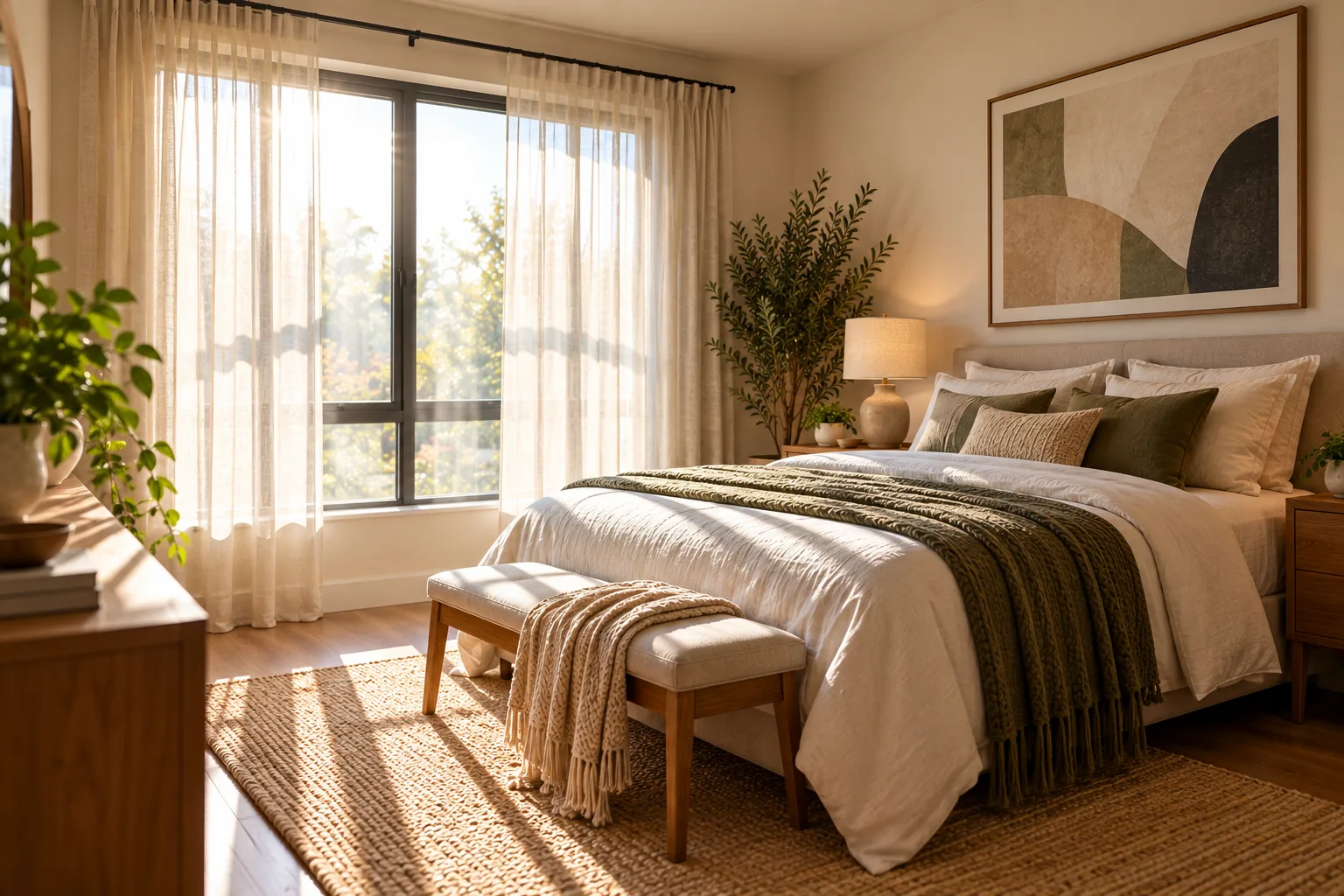
A bedroom can have gorgeous linen sheers, perfectly styled bedding, and still let in enough early light to disrupt sleep every single morning. Swapping to a blackout liner behind the same sheers keeps the exact look while actually solving the problem — the fix is almost always invisible from a styling standpoint.
The Guest-Room-Turned-Office
A bedroom with a desk tucked in the corner, positioned so the monitor is visible from the bed, undercuts the room's main job every single night even if the desk itself looks tidy. Turning the desk to face away from the bed, or relocating it to a hallway nook entirely, resolves this without buying anything new.
The Clutter-Free Room That Still Feels Unfinished
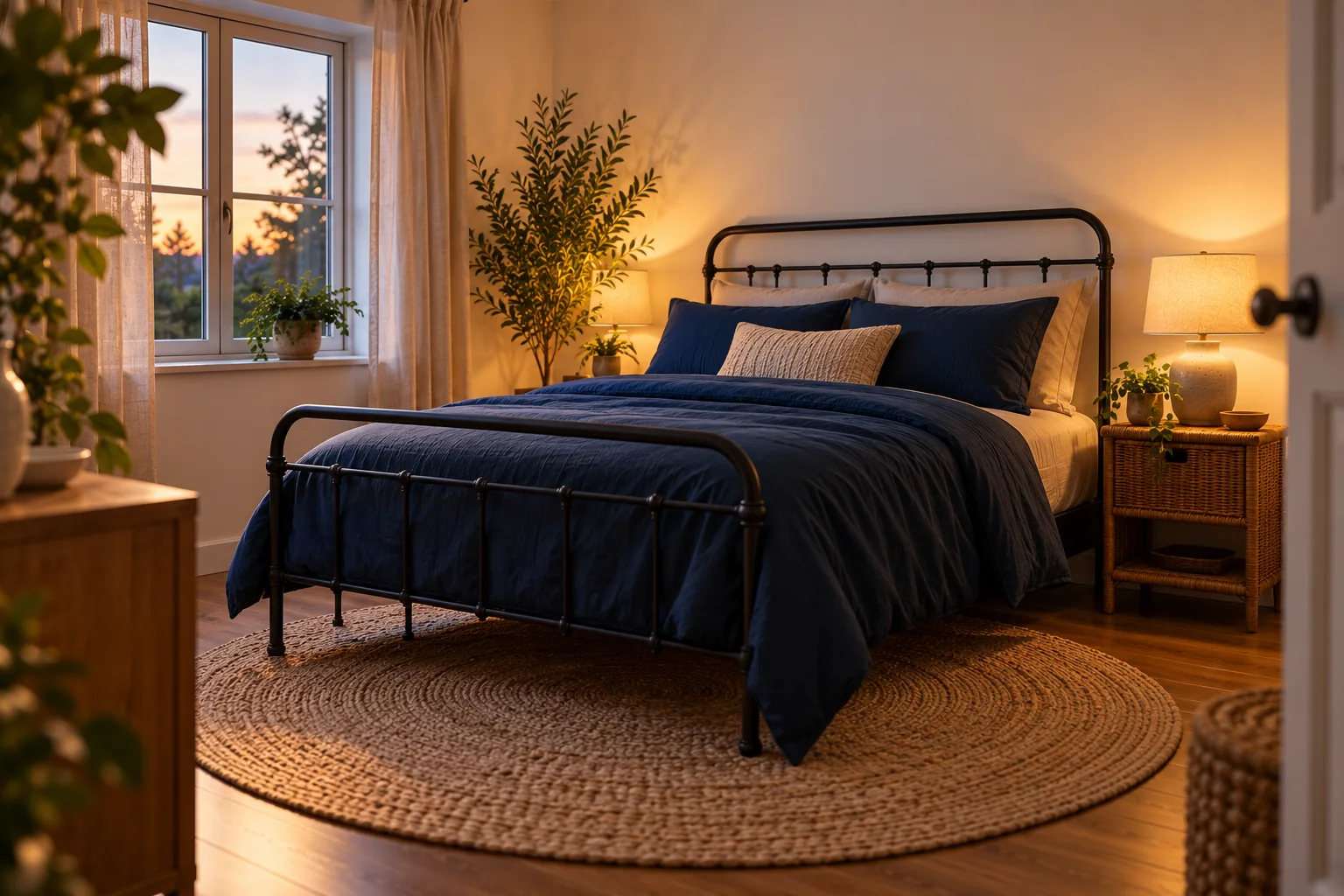
Sometimes a bedroom is genuinely tidy and still doesn't feel restful because the floor is bare and the lighting is a single bright overhead fixture — the same layering principle covered in our guide on choosing the right rug size for every room applies here: a rug sized to extend well past the sides and foot of the bed does as much for a bedroom's calm feeling as decluttering does.
Common Mistakes
Mistake: Relying on curtains that look good but don't block light. Sheer or thin curtains are a styling choice, not a light-control solution — pair them with a blackout liner rather than choosing one or the other.
Mistake: Charging phones on the nightstand. Beyond the light and notification interruptions, a charging phone within reach keeps the room functioning as an extension of work and scrolling rather than a place separate from both. A charging station outside the bedroom is a small change with an outsized effect.
Mistake: Treating "matching" as the same thing as "calm." A perfectly coordinated bedding set doesn't fix light leaking in or a desk in the sightline. Coordination is a finishing touch, not a substitute for the three drivers above.
Mistake: Adding a TV to "wind down" with. A screen at the foot of the bed works against the exact thing a bedroom is supposed to do, regardless of how the room is styled around it — this is one case where the practical fix is subtraction, not addition.
What This Actually Costs
A blackout curtain liner runs $20 to $50 per window and can be added behind existing curtains without replacing them. A pair of warm-toned bulbs for evening lamps costs $10 to $20. A properly sized bedroom rug is the largest expense here, typically $150 to $350 for an average room — but it's also optional if the room's main issues turn out to be light and clutter rather than bare flooring. Diagnose first with the two-minute test above, then spend only on what that test actually revealed.
A Restful Bedroom Checklist
- Does the room go genuinely dark, not just dim, when you want it to?
- Is evening lighting warm-toned and lamp-based rather than a bright overhead fixture?
- Is there anything visible from the bed that represents unfinished work — a screen, a pile, a desk?
- Does the bed have a rug that extends well past its sides and foot, if the floor is otherwise bare?
- If the room serves a second function, is that function physically out of the bed's direct sightline?
If your bedroom is furnished but the proportions still feel slightly off — a bed that's a little too large or too small for the space — our guide on choosing furniture that actually fits your room covers how to check that specifically before assuming the room's problem is only about light and clutter.
Restful Isn't the Same as Styled
A bedroom becomes restful through what it controls — light, visible clutter, and how many jobs it's asked to do at once — not through how well the bedding is coordinated. Most of the fixes above cost less than a throw pillow and take an afternoon, which makes this one of the highest-return changes available in the entire house.
Why doesn't my bedroom feel relaxing even though it's nicely decorated?
Rest depends on how a room functions at night and in the early morning — light control, visible clutter, and how many jobs the room does — none of which shows up in how well-styled the room looks during the day.
What's the single most effective change for a more restful bedroom?
Real light control — a blackout liner behind existing curtains and warm-toned evening lamp lighting — usually has the biggest effect for the lowest cost of anything on this list.
Is it bad to have a desk in the bedroom?
Not necessarily, but it should be positioned so it's not visible from the bed. A desk and monitor in your direct sightline keeps the room functioning as a workspace even after you've stopped working.
Does a rug actually make a bedroom feel more restful?
Yes, in the same way it works in a living room — a properly sized rug under and around the bed adds warmth and softens a room that would otherwise feel bare and slightly clinical.